
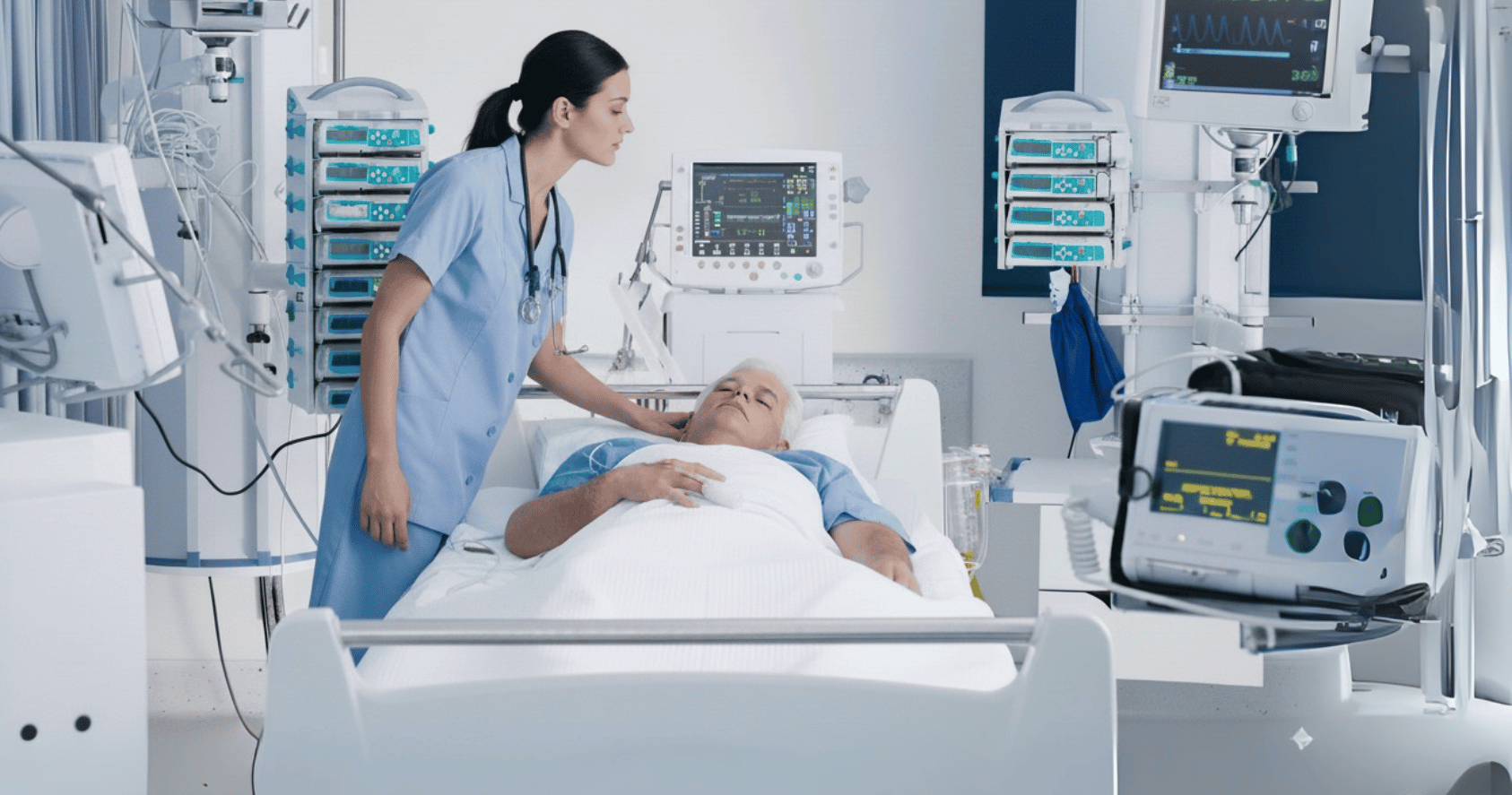
Hospital acquired pneumonia (HAP) still fails to respond to standard antibiotic regimens in roughly one third of cases and remains a major cause of death in intensive care. A new paper in Intensive Care Medicine reports that this high failure rate may be driven by two biologically distinct patient phenotypes that can already be recognised at the bedside.
Researchers from the Homi Lung–linked HAP² consortium, which aims to develop host directed drugs and biomarkers to enhance the prevention and treatment of hospital acquired pneumonia, collated five independent cohorts drawn from France, the Netherlands, Spain/Latin America and an international randomised trial, covering 3,889 critically ill adults with HAP or ventilator associated pneumonia. Using unsupervised clustering on routine clinical data, they consistently identified two reproducible sub phenotypes. Patients in Sub phenotype 2 were older, more hypoxic, more likely to be in septic shock, and had 28 day mortality and treatment failure rates up to twice those of Sub phenotype 1 across all derivation cohorts.
From discovery to a practical score
To make the approach usable in everyday practice, the investigators distilled the signal into a 13 variable bedside tool called PHOENYCS (Pneumonia with a History of lung/renal disease or immunOsuppression, in Elderly, with No fever and high severitY Classification System).
A PHOENYCS probability ≥ 0.20 classifies a patient as high risk Sub phenotype 2. The model showed good discrimination when applied, without re fitting, to three external validation cohorts (AUROC 0.69–0.87).
Biology that matches the bedside picture
Endotracheal aspirates showed that Sub phenotype 2 lungs had depleted “healthy core” genera such as Veillonella and Streptococcus, with markedly lower microbial diversity, consistent with severe dysbiosis. Blood profiling revealed a parallel hyper inflammatory state dominated by IL 18, IL 6, IL 1α and TNF α—a pattern providing a plausible mechanistic link to the excess organ failure and mortality seen clinically.
Therapeutic implications
When the score was applied to the VITAL trial (tedizolid vs linezolid), treatment response differed by phenotype: linezolid was superior in Sub phenotype 1, whereas outcomes were similar in the high risk group. This interaction highlights how stratification may prevent both overtreatment of low risk patients and undertreatment of those who require more than a standardised approach.
A shared effort between HAP² and Homi Lung researchers
The study was led by co first authors Dr Florian Pierre Martin and Dr Cécile Poulain (CHU Nantes, Nantes Université), with Prof Antoine Roquilly (CHU Nantes, Nantes Université) as senior and last author. Prof Roquilly coordinates both the HAP² and Homi Lung projects, and this publication reflects one of the many scientific bridges between the two initiatives.
Reference
Martin FP, Poulain C, Haitsma Mulier J, Motos A, Gourain V, Ogan I, Montassier E, Launey Y, Lasocki S, Cinotti R, Dahyot Fizelier C, Ranzani O, Reyes LF, Martin-Loeches I, Derde L, Torres A, Cremer O, Roquilly A. Identification and validation of robust hospital-acquired pneumonia subphenotypes associated with all-cause mortality: a multi-cohort derivation and validation. Intensive Care Med. 2025;51:692–707. doi:10.1007/s00134-025-07884-3